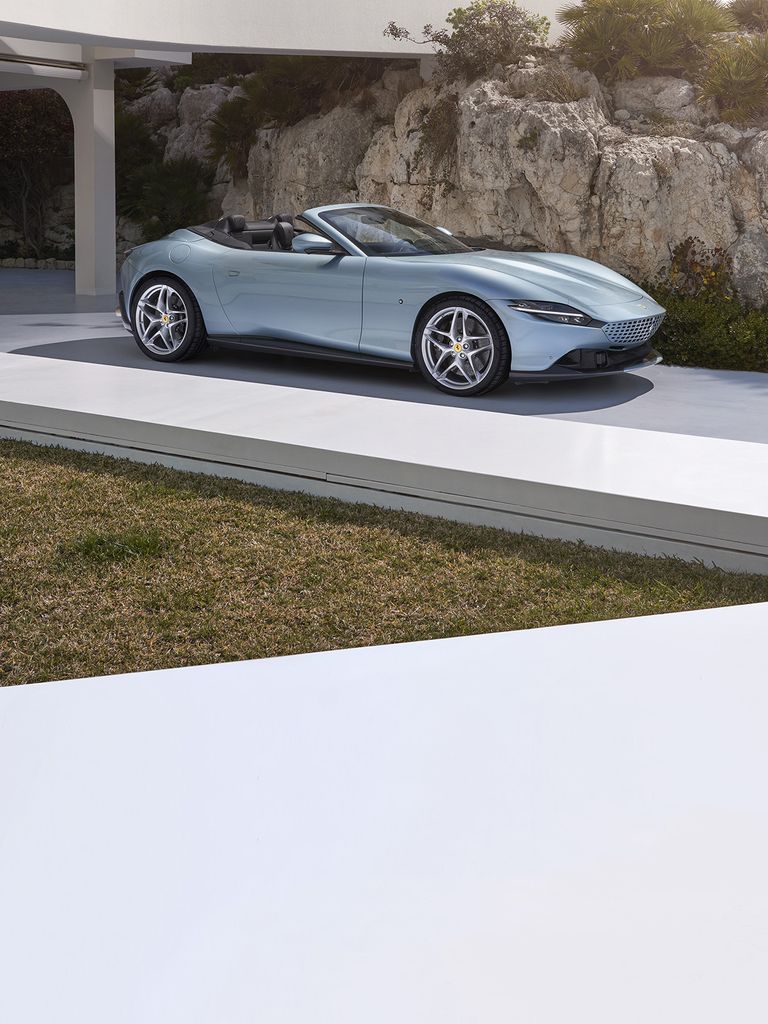
Ferrari has the pleasure of inviting you to experience the new Ferrari Roma Spider, as part of a unique test drive event. Set in the forested hills outside Rome in the nestled town of Fiuggi, you can enjoy one of the most exclusive wellness retreat properties and the relaxing landscapes around it.
The two days schedule will feature the following highlights:
Located on an ancient hilltop in its own private 8-hectare park, Palazzo Fiuggi offers unrivalled views over an exquisite landscape, made verdant by the rich mineral waters that flow through it. At 700m above sea level, guests will luxuriate in the clean, oxygen-rich air that creates the ideal altitude for personal rejuvenation.
DISTANCE FROM THE AIRPORT
1:15h / 100km from Fiumicino airport
1:00h / 75km from Ciampino airport
DAY 1
12.00 – 14.00 Arrival and accreditation
12.30 – 14.30 Welcome served buffet lunch
14.00 – 18.00 Test Drive on road – first session
Briefing session before each test drive slot
20.00 – 22.30 Welcome drink and dinner
DAY 2
07.00 – 09.30 Breakfast
09.00 Check-out
09.00 – 13.00 Test Drive on road – second session
12.00 – 14.00 Served lunch
Additional activities available on-site.
The Route Challenge on Road
The test drive sessions on road will allow you to fully enjoy a new harmony of form and performance with the Ferrari Roma Spider. The dynamic roads, carefully selected and tested by the professional drivers of Scuderia de Adamich, allow you to fully test this timelessly elegant, high-performance soft-top car and its incredible driving pleasure.
The Ferrari Roma Spider is a timelessly elegant, high-performance car, but also a contemporary take on the chic, pleasure-seeking Italian lifestyle of the 1950s and 60s. This spider carries over the proportions, volumes and specifications of the Ferrari Roma’s hugely successful concept, but what makes it so striking is the adoption of a soft top, a solution making a welcome return to the Prancing Horse range on a front-engined car 54 years after the launch of the 1969 365 GTS4
The values of fuel consumptions and CO2 emissions shown were determined according to the European Regulation (EC) 715/2007 in the version applicable at the time of type approval.
The fuel consumption and CO2 emission figures refer to the WLTP cycle.
The values of fuel consumptions and CO2 emissions shown were determined according to the European Regulation (EC) 715/2007 in the version applicable at the time of type approval. The fuel consumption and CO2 emission figures refer to the WLTP cycle.
In order to be placed on the market, passenger cars carry out a series of tests to verify their compliance with regulations.
The tests to assess fuel consumption, CO2 and pollutant emissions are carried out in the laboratory and are based on specific driving cycles. In this way, the tests are reproducible and the results comparable. This is important because only a laboratory test, which follows a standardized and repeatable procedure, allows consumers to compare different car models. On 1 September 2017, the new Worldwide harmonised Light-duty vehicle Test Procedure (WLTP) came into force in Europe and will gradually replace the New European Driving Cycle (NEDC) protocol. NEDC (New European Driving Cycle): it has been the European driving cycle used so far for the measurement of fuel consumption and emissions from passenger cars and light commercial vehicles. The first European driving cycle came into force in 1970 and referred to an urban route. In 1992 it was also considered to have an extra-urban phase and since 1997 it has been used for measuring consumption and CO2 emissions. However, the composition of this cycle is no longer consistent with current driving styles and distances travelled on different types of roads. The average speed of the NEDC is only 34 km/h, accelerations are low and the maximum speed is just 120 km/h. WLTP procedure: WLTP uses new Worldwide harmonised Light-duty vehicle Test Cycles (WLTC) to measure fuel consumption, CO2 and pollutant emissions from passenger cars and light commercial vehicles. The new protocol aims to provide customers with more realistic data, better reflecting the daily use of the vehicle. The new WLTP procedure is characterized by a more dynamic driving profile with more significant acceleration. The maximum speed increases from 120 to 131.3 km/ h, the average speed is 46.5 km/h and the total cycle time is 30 minutes, 10 minutes more than the previous NEDC. The distance travelled doubles from 11 to 23.25 kilometers. The WLTP test consists of four parts depending on the maximum speed: Low (up to 56.5 km/h), Medium (up to 76.6 km/h), High (up to 97.4 km/h), Extra-high (up to 131.3 km/h). These parts of the cycle simulate urban and suburban driving and driving on extra-urban roads and motorways. The procedure also takes into account all vehicle’s optional contents that affect aerodynamics, rolling resistance and vehicle mass, resulting in a CO2 value that reflects the characteristics of the single vehicle.
The WLTP procedure will gradually replace the NEDC procedure. The WLTP applies to new passenger car models from 1 September 2017, to all passenger cars registered from 1 September 2018 and is mandatory for all EU Member States. Until the end of 2020, both fuel consumption and CO2 emission values in WLTP and NEDC will be present in the vehicle documents. Indeed, NEDC values will be used to assess the average CO2 emissions of cars registered in the EU throughout 2020. In addition, some countries may continue to use the NEDC data for fiscal purposes. From 2021 onwards, WLTP data will be the only consumption/ CO2 emissions values for all cars. Used vehicles will not be affected by this step and will maintain their certified NEDC values.
ROAD CONSUMPTION AND EMISSIONS OF PASSENGER CARS
The new WLTP test procedure is more representative of current driving conditions than the NEDC procedure, but it cannot take into account all possible cases including the effect of the driving style that is specific to each individual driver.
Therefore, there will still be a difference between emissions and consumption measured in the laboratory and those resulting from the use of the vehicle in the real world, and the extent of this difference will depend on factors such as driving behavior, the use of on-board systems (e. g. air conditioning), traffic and weather conditions that are characteristic of each geographical area and each driver. For this reason, only a standardized laboratory test allows to obtain values with which it is possible to compare vehicles and different models in a fair way.
WHAT CHANGES FOR CUSTOMERS
The new WLTP procedure will provide a more realistic criterion for comparing the fuel consumption and CO2 emission values of different vehicle models as it has been designed to better reflect real driving behavior and take into account the specific technical characteristics of the individual model and version, including optional equipment.
Visit the Ferrari Online Configurator to explore and experiment with the many options available with the Ferrari Roma Spider. Create perfectly rendered images based on the options you select, and refine your choices as you build your dream Ferrari Roma Spider.
Once you are satisfied with your configuration you can save it to your MyFerrari account and generate the QR code so you can share your creation with your dealer. For those looking for the ultimate expression in personalisation, the Atelier Ferrari is a truly exclusive, sophisticated space where you can create your very own bespoke car with the assistance of a team of experts. Atelier appointments can now be held remotely, contact your dealer to arrange your V-Appointment.